About
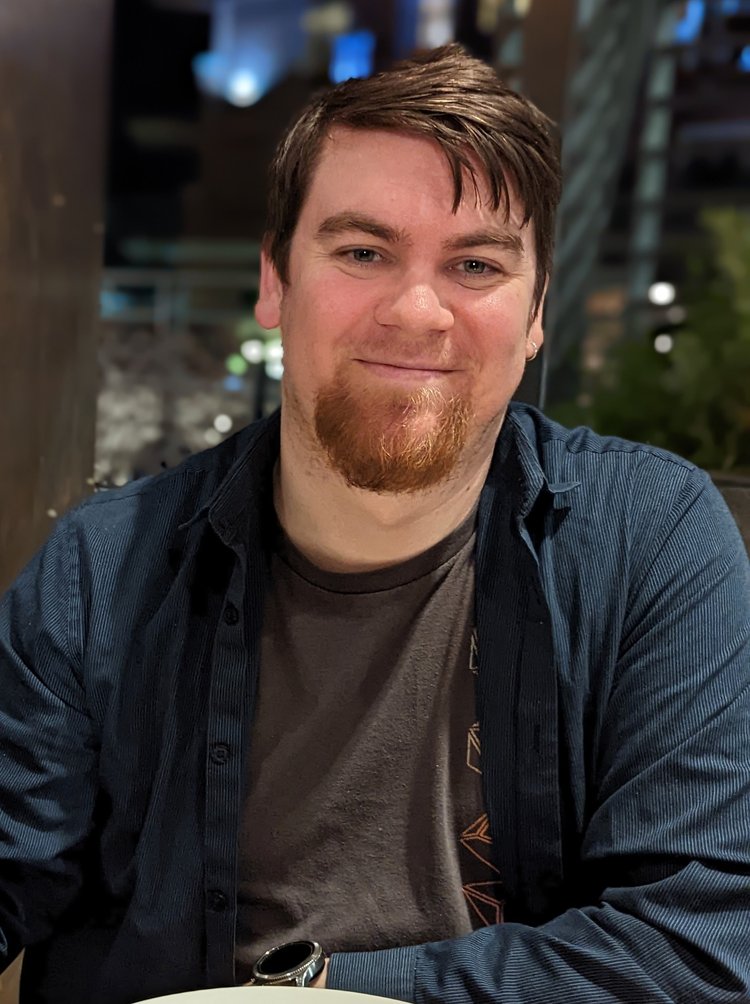
Adam Johns, MA, LMFT
Licensed Marriage and Family Therapist based in Mountlake Terrace, Washington, with more than a decade of experience at the intersection of clinical practice and gaming culture.
Licensed Marriage and Family Therapist based in Mountlake Terrace, Washington, with more than a decade of experience at the intersection of clinical practice and gaming culture.
I became a therapist because I was interested in the question of how people change — what makes therapy actually work, how identity gets built and remade, and how the things people love (their stories, their characters, their interests) might be more central to that work than traditional therapy gives them credit for.
I earned my MA in Marriage and Family Therapy from Antioch University Seattle in 2013, and have been a Licensed Marriage and Family Therapist in Washington State since 2016. My clinical training was generalist; my specialization has been built over a decade of focused practice with neurodivergent clients, the geek and gaming community, and adults navigating major transitions.
From 2017 to 2022, I co-founded and co-led Game to Grow, a 501(c)(3) nonprofit that pioneered the therapeutic and educational use of tabletop roleplaying games. During that time I served as co-Executive Director, led the development of Critical Core — the therapeutic RPG system now used in clinics around the world — and co-authored Therapeutically Applied Role-Playing Games: The Game to Grow Method (Routledge, 2023), a comprehensive clinical training manual for the modality.
Today, my work is split between private practice in Mountlake Terrace and ongoing speaking, training, and consultation work in the field I helped establish.
Therapy, at its best, is a collaboration between two people trying to understand one person better. I bring training, frameworks, and clinical judgment; you bring expertise on your own life that I don't have. Good therapy threads those together.
I work from a stance that affirms LGBTQ+ identities and neurodivergence as ways of being in the world, not problems to manage. I have ADHD myself, and a lot of my work — both clinical and outside the office — has involved learning how to work with a brain that doesn't run on neurotypical defaults rather than fighting it into compliance. That perspective shapes how I sit with clients who are navigating similar territory.
My approach is integrative and skills-informed. I draw on CBT, DBT, IFS, ACT, and narrative therapy depending on what's actually useful in front of me. I tend to focus on understanding (what's actually happening for you and why), skills (practical tools for the moments you need them), and story (the narratives you carry about yourself and the world, and which ones still serve you).
And I try to keep a strengths-oriented lens. The patterns that bring you to therapy are usually older than they look, and most of them started as something that protected or served you. The work isn't to villainize those patterns. It's to understand what they were doing for you, and to figure out — together — what you'd like to do now.
I've been playing tabletop roleplaying games since I was ten. These days I play video games, board games, and TTRPGs across a range of systems, and I'm a regular attendee at conferences like PAX, Geek Girl Con, and OrcaCon — sometimes as a speaker, sometimes just because I enjoy them. My tastes run toward high fantasy, science fiction, superheroes, and anime.
This isn't separate from my work. Geek culture isn't a hobby I happen to have — it's a community I'm part of, a language I'm fluent in, and a meaningful framework for how I think about identity, story, and growth.
"Being a geek is all about being honest about what you enjoy and not being afraid to demonstrate that affection. It means never having to play it cool about how much you like something. It's basically a license to proudly emote on a somewhat childish level rather than behave like a supposed adult. Being a geek is extremely liberating."
When I'm not gaming or working, I'm usually outside with my family — hiking, surfing, or camping. The Pacific Northwest is a good place for all three.
Whether you're looking for therapy, considering Forged in Story, or interested in speaking, consultation, or collaboration — reach out and let's talk.
Get in touch